
Question: Mr. Trump reportedly pushed hard for this call with Mr. Xi. What do you think was driving that urgency, and did he get anything meaningful out of it?
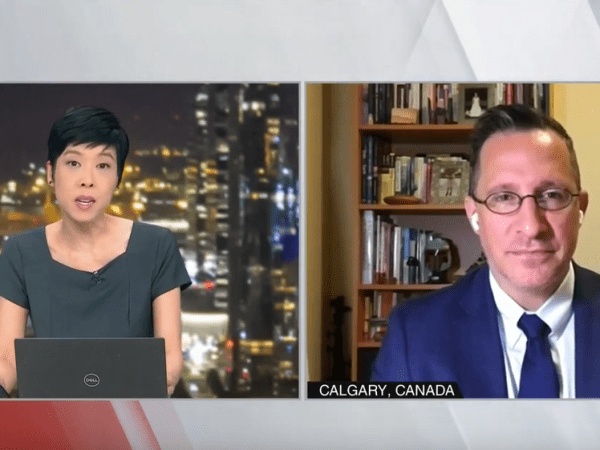
Stephen Nagy: Well, I think that looking at the readouts from both the Chinese side and the American side, it looks like the Chinese side has a much more subdued conclusion to the call, whereas Mr. Trump, in his typical salesman-like way, generally upsells the results. So, I think that’s the first message — that both sides are on a different page of the book in terms of where this call went.
Second, I think that President Trump is looking at the markets, he’s looking at the challenges that are mounting to the American economy, and the lack of, I think, real success of “Liberation Day,” and trying to find ways to walk back from this. And, you know, China is the biggest prize, I think, for Mr. Trump. Touting a successful call with Mr. Xi and having that call is a political win for him — although it may not have any actual substance to date.
Question: Do we have reason to be optimistic? Or is this just an agreement to talk some more? Because if you look at markets, they don’t seem particularly convinced.
Stephen Nagy: I don’t think any specialists that look at this most important bilateral relationship are convinced that there’s been any substantial change in the tensions and the competition between the two.
We look at the relationship through a technological competition — who’s going to win it, and who’s going to shape the rules of trade and technology over the 21st, 22nd, and 23rd centuries. The trade talks themselves are really, I think, just the first round in a very, very long battle.
Again, they’re both looking for a political win. Perhaps Mr. Trump is looking for some kind of economic gain over the summer to get some momentum behind him as he moves into other initiatives. And the reality is, the Chinese economy is still dependent on the export market of the United States. Nothing’s going to replace that 800 billion dollars of trade that China has with the U.S. — and that means millions and millions of jobs in China.
So, they both have incentive to come and talk, and step back. But over the long term, I think this competition is going to deepen.
Question: President Trump said the call was all about trade — and not much else. No Iran, no Ukraine, no South China Sea. At this point in time, what about his global outlook. Is he picking his fights? Because it seems to go against the idea that the U.S. now sees China as its main antagonist — in the Indo-Pacific, and for that matter, the rest of the world.
Stephen Nagy: I think you hit the nail on the head. We see a big inconsistency in the Trump policy. And we’ve seen, really, not many successes. He said he’d solve the Ukraine war in one day — and obviously, that hasn’t happened. The issues in Gaza haven’t been solved. The issues with Iran, and others — the same.
He’s looking for a political win. He’s a transactional president. He doesn’t see the world in the traditional way that many of us do — that it’s not a zero-sum way of engaging with other countries. He thinks he can get some kind of deal with China.
I think the Chinese, though, have understood his card game, and they’re going to play very, very hard on this one. They’re going to push back and try to get some short-term relief so they can keep their economy moving in a better direction, because it’s facing severe structural pressures.
Again, Mr. Trump has not been successful — but I think there’s motivation and incentive on the Chinese side to come to the table for some kind of short-term agreement on trade.
Question: You earlier pointed out the discrepancy in the readouts between the two sides. The Chinese readout emphasized Taiwan. What does that tell you about how Beijing is framing its priorities?
Stephen Nagy: Well, obviously, Beijing has not changed its position on Taiwan. It continues to say it would like to pursue peaceful reunification, but it doesn’t renounce the use of force.
In every communiqué with the United States, it continues to say Taiwan is that critical red line for the Chinese — and that any movement by the U.S. that changes the current status, or pursues something more unilateral in terms of recognition, is ultimately going to be game over for the bilateral relationship.
So, the Chinese are putting that on the table, saying: if you recognize our interests — if you recognize the One China Policy publicly, and move away from strategic ambiguity in the U.S. position — then we can probably move forward on trade talks and deescalate this very important relationship and long-term strategic competition.
But from the Chinese side, this is the starting point and probably also the endpoint of negotiations. Taiwan is not negotiable — from their standpoint.
Question: What the nature of this deal — short-term or otherwise — is going to look like. Because Xi said both countries should seek win-win results in the spirit of equality and respect. Does Trump do win-win? Does he accept compromise with China?
Stephen Nagy: You know, I think on both sides there’s recognition that some kind of rebalance is needed in the relationship. But in Trump’s White House, he doesn’t seem to recognize that the trade balance reflects comparative advantages and the mutual benefits both societies provide each other.
On the Chinese side, they do recognize the need to boost domestic consumption and get the economy moving. Among economists and those trying to restructure China’s economy, there’s recognition that some of Trump’s demands make sense.
The question is: do they take maximalist approaches on both sides? Mr. Trump’s track record is that he starts with a maximalist approach and ends up with a minimalist position. So, I think there’s an opportunity for China to buy more American goods, to open up its economy to some extent — but not to the extent Trump is demanding.
And from the U.S. side, I think there’s an opportunity to bring a bit more clarity to the Taiwan issue — perhaps engage in reducing tariffs in a way that’s not so damaging to the Chinese economy, and still declare peaceful coexistence — a so-called “win-win,” as you put it.
The reality is, if both leaders stay in power, my sense is the Chinese are digging in for a long fight. Mr. Trump, meanwhile, is playing to his MAGA audience — rather than focusing on the fundamentals of the U.S. economy or looking deeply at the challenges and opportunities that exist in U.S.-China economic engagement.
Question: When it comes to leverage, which side actually holds the stronger negotiating position right now?
Stephen Nagy: This is a real tough one. On one hand, the U.S. is a consuming country. Christmas is coming up — they’re going to want to buy a lot of goods, and most of those will come from China. Now, Americans can probably make do with fewer presents under the tree — but the challenge comes on the Chinese side. Can they handle a dramatic reduction in goods exported to the U.S.? The Chinese economy is still manufacturing-based. It produces a lot of goods not just for the Global South, but for rich Western economies like the U.S. It needs those markets to keep millions of people employed in the factories along the east and south coasts.
Losing those markets has a huge impact — not just once, but twice. First, it hits the factory workers directly. Second, it disrupts the economic model developed since reform and opening up in 1978 — where migrant workers earn, save, and send money back to their hometowns during Chinese New Year to support local development.
Without those jobs, that model breaks. It creates pressure not only in the manufacturing zones but also in rural development. So, in that sense, I think the Chinese really do need to get to the table in the short term to deal with these emerging unemployment challenges.









 nagystephen.com
Leave a comment