
U.S. President Donald Trump recently took to the podium to air a familiar grievance, lambasting America’s closest allies including NATO members, Japan, South Korea and Australia for failing to provide concrete military support to the U.S.-Israeli war with Iran.
To the White House, this reluctance is a betrayal, a sign of free-riding nations unwilling to shoulder the burden of global security. But to understand the hesitation in Tokyo, Ottawa, Berlin, Canberra and Seoul, one must look past the rhetoric and examine the reality of this conflict.
The allies are not abandoning the U.S.; they are recoiling from a war that lacks a defined strategy, achievable objectives, consistent messaging and a commitment to post-conflict diplomacy. In short, they are being asked to bleed for a war of choice without a clear rationale.
History shows that American allies are more than willing to stand shoulder-to-shoulder with Washington when the mission is clear. Compare the current fractured landscape with the coalition U.S. President George H.W. Bush assembled for the First Gulf War (1990-1991). That effort was a masterclass in diplomacy, grounded in international law, with a singular, achievable objective: to expel Iraqi forces from Kuwait. Similarly, the coalition forged after the Sept. 11, 2001, terrorist attacks on the U.S. was bound by the undeniable necessity of self-defense and a shared moral outrage. More recently, in 2022 the Biden administration successfully rallied a global coalition to arm and fund Ukraine against Russia’s invasion anchored by a clear narrative of defending sovereign borders against unprovoked aggression.
What is different today? In each of those historical examples, the U.S. engaged in consultation, established clear red lines and articulated what victory looked like. The current U.S.-Israeli campaign against Iran offers none of these assurances. As Richard K. Betts and Stephen Biddle argue in their recent Foreign Affairs article, “The Price of Strategic Incoherence in Iran,” a legitimate war must be accompanied by a strategy that can achieve its purpose at an acceptable price. They rightly point out that the administration’s fallback option of “mowing the lawn” by periodically bombing Iran to degrade its capabilities is unworkable, technically infeasible and merely fuels Tehran’s incentives for retaliation.
As much as Trump wants to trumpet his recent and already questionable two-week ceasefire with Iran as a “total and complete victory,” his war aims remain all over the map — regime change? denuclearization? destroying Hezbollah and Hamas? — and his secretary of war, Pete Hegseth, says, U.S. forces will not be leaving the Gulf any time soon.
The winners and losers of this chaotic approach are already emerging. The undeniable winners are Beijing and Moscow. For Russia, the conflict is a vital distraction. Furthermore, as Maya Sobchuk wrote last June in a noteworthy report for the Cyfluence Research Center, “To understand the nature of modern Chinese influence operations, study Russia first,” China and Russia are actively collaborating in the information space, utilizing digital propaganda to frame Western involvement as destabilizing.
Yet, China’s “victory” is complex. As Zongyuan Zoe Liu explains in her Foreign Affairs essay last month, “What the Iran War Means for China,” Beijing actually fears American volatility more than American power. China depends on a stable global economy and open sea lanes. A prolonged war that damages Middle Eastern oil infrastructure threatens China’s energy security. Beijing does not want an unpredictable, unconstrained U.S. detonating the very system China relies upon for its continued economic ascent.
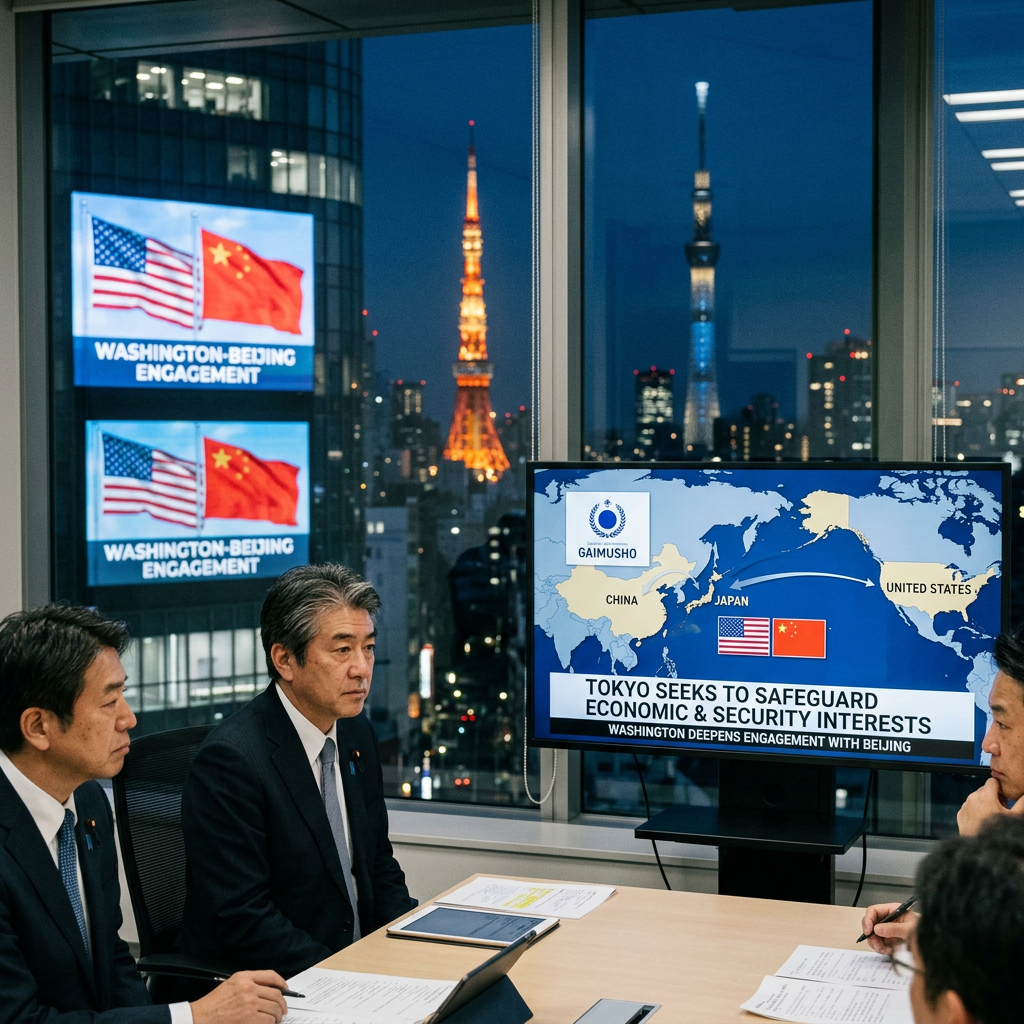
Nowhere is this dilemma more acute than in Tokyo. Prime Minister Sanae Takaichi finds herself forced to thread an impossibly narrow needle. The Japanese have a piercing proverb for this exact type of impossible situation: Mae ni umi, ushiro ni yama (The sea in front, the mountain behind). Caught between a rock and a hard place, as they say in the West, Takaichi is expected to aid the U.S. in a war her public largely opposes while managing the economic fallout as well as the looming threat of China.
The reasons Takaichi and other allied leaders cannot simply satisfy Washington’s demands are threefold. First, the continuation of the war is economically unsustainable. Japan, like Europe and South Korea, is deeply dependent on Middle Eastern energy. Spiking oil prices and the resulting inflationary pressures are battering the Japanese economy, threatening to drag the broader global economy down with it.
Second, the brutal reality of alliance politics dictates that Japan cannot expect America to aid in its defense if it refuses to support the U.S. in its time of need. However, this assistance cannot be demanded without consultation. It must be offered on allied terms, especially when Washington has bypassed the vital steps of strategic planning and failed to articulate a postwar diplomatic off-ramp.
Third, and most importantly, Japan’s existential priority is preventing China from becoming the regional hegemon in the Indo-Pacific. If one thing has become clear recently, U.S. security guarantees are no longer guaranteed, even in the face of a Taiwan contingency. Yet without the United States, balancing Beijing is mathematically impossible. The 2025 Lowy Institute’s Asia Power Index starkly illustrates this. Even if Japan and India were to combine their comprehensive national powers, they would still fall short of countering China’s immense capabilities. Tokyo needs Washington anchored in the Pacific, which means it cannot afford a total rupture over the Middle East.
How, then, do middle powers navigate this choice of poisons? A viable framework can be found in my recent report for the Asia Pacific Foundation of Canada, “Strategic Choices for Middle Powers Navigating U.S.-China Competition.” In the report, published in February, I argue for “hardened engagement.” This approach suggests that allies should avoid binary choices of military deployment or total abandonment. Given the Trump administration’s lack of clarity, allied leaders should adopt the following three strategies to navigate the crisis.
First, allies must provide asymmetric and logistical “gray-zone” support rather than direct combat assistance. Nations like Japan and Australia should refuse direct kinetic roles in Iran but offer robust rear-echelon support. This includes intelligence sharing, cybersecurity cooperation against Iranian state hackers and logistical backing outside the immediate theater of conflict. By doing so, allies fulfill their treaty obligations and demonstrate solidarity without owning the kinetic consequences of a strategyless war. This also allows them to maintain their alliance commitments while shielding their domestic populations from the direct fallout of a deeply unpopular military adventure.
Second, middle powers must take the initiative to lead the postwar diplomatic off-ramp. Because Washington has failed to articulate a “day after” plan, allies should step into the vacuum. Japan, alongside European partners, should publicly draft and promote a diplomatic framework for regional stability, reconstruction and de-escalation. This signals to the global community that their involvement is strictly geared toward achieving peace, mitigating the exact type of systemic unraveling that Beijing and Moscow hope to exploit. It also positions these allies as responsible stakeholders in the liberal international order, contrasting sharply with the unilateralism currently emanating from the White House.
Third, these nations should implement strategic burden-shifting in the Indo-Pacific. Instead of sending valuable military assets to the Middle East, Japan, Australia and South Korea should offer to take on a greater share of the security burden in their own neighborhoods. By increasing maritime patrols in the South China Sea, expanding joint military exercises and taking over certain conventional deterrence responsibilities, allies can effectively free up American naval and air assets. This directly supports the U.S. military globally while keeping allied forces focused on their primary, existential threat — an increasingly assertive China.
Alliances are not protection rackets; they are partnerships built on mutual trust, shared risk and coherent strategy. President Trump’s frustration with his allies is misplaced but also understandable; for generations the U.S. has shed blood for itself and its allies. Notwithstanding, if Washington wants the world to march behind it, it must first decide where it is going. Until then, allies like Japan will have to survive in the gray zone: managing the sea and the mountains of a war they did not choose to preserve the alliance they cannot live without.
First published with the Japan Times April 9th, 2026 (https://www.japantimes.co.jp/commentary/2026/04/09/world/indo-pacific-iran-war-price/)


Leave a Reply