
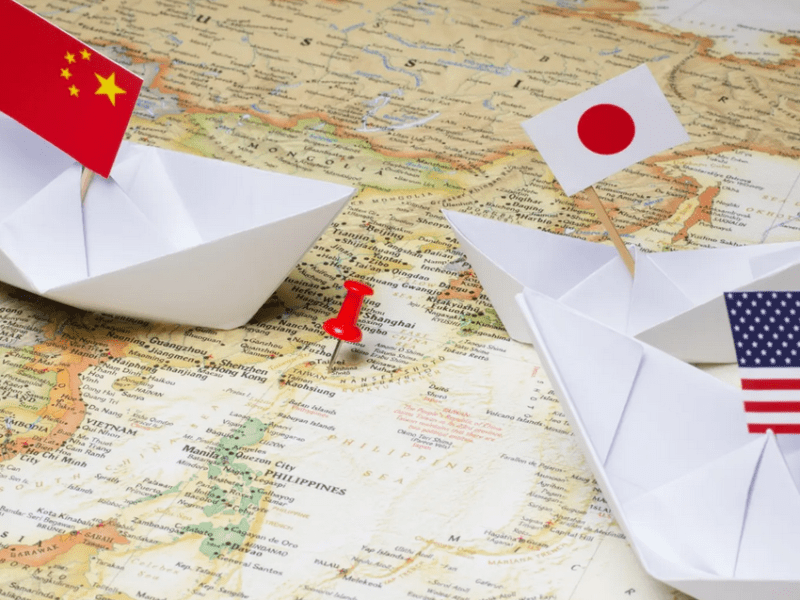
JJapan’s strategy in the Indo-Pacific region has become increasingly under question as it promotes its so-called “Free and Open Indo-Pa- cific Vision” (FOIP). Viewed from Beijing, the vision is understood as a containment strategy that works synergistically with the U.S. foreign policy to maintain its hegemonic position in the region. Other states such as Australia, India, and the E.U. view the vision primarily through the lens of a set of policy initiatives that aim to buttress the rules-based order through a process of accommodation of China’s re-emergence as the dominant economy in the region and hedging, primarily through the Japan-U.S. alliance.
Examining Japan’s foreign policy towards the Indo-Pacific (Asia-Pacific) within the parameters of this chapter, Yoshimatsu (2020) has grouped research done on Japan’s foreign policy into four categories: 1) proactive security engagement in the region; 2) theoretical categorisations of the Abe administration’s foreign policy; 3) the domestic policy-making in relation to the Abe administration’s foreign policy; and 4) efforts to understand the underlying assumptions behind Japan’s Indo-Pacific foreign policies.
Interpretations of the proactive security engagement in the region identified by Yoshimatsu include Suzuki and Wallace (2018), Gaens (2018), and Smith (2019). The former argue that foreign policy has been determined by the interaction of geopolitical vulnerability, pacifist influences, and “political revisionist self-limiting” postures resulting in an Indo-Pacific approach that is less securitised than one would predict based on the threats emerging out of North Korea and China’s military expansion.
Smith largely concurs with these points stressing that real changes in Japan’s foreign policy and defence po- sture have been “additive not innovative” with few in the Diet willing to deploy self-defence forces abroad. Gaens (2018), in contrast, argues that Japan’s foreign policy vis-à-vis the region demands a more engaged Japan at the regional and global level through the expansion and deepening of strategic partnerships.
Theoretical categorisations of the Abe administration’s foreign policy in the Indo-Pacific fall on the continuum of balancing to hedging, to Japan attempting to address concerns about entrapment and abandonment. Collectively, these works attempt to explain the link between foreign policy changes in the Indo-Pacific and strategies to deal with security concerns associated with China’s rise.
Scholars such as Mulgan (2018) and Shinoda (2018), who investigated domestic policy-making in relation to the Abe administration’s foreign policy, argue that the long tenure of Abe provided the time and conditions to come up with and execute a consistent (and strategic) foreign policy for the Indo-Pacific that was not achievable for nearly two decades of revolving door leadership.
Research to understand the underlying assumptions behind Japan’s Indo-Pacific foreign policies has also been conducted to explain FOIP’s normative character, that is the promotion of a rules-based order. Here, scholars such as Hatakeyama (2019), Asplund (2018), and Nagy (2021) have found that Japan has shifted away from a reactive, agnostic foreign policy in the Indo-Pacific to one that prioritised the advocacy of a rules-based order in the region over explicit democracy and human rights promotion.
What is clear for security policy analysts is that the FOIP is ambiguous and seen as evolving to encompass different components. In a sense, it is seen as both a reactive and a proactive policy, fusing the concept of Japan as a reactive state and Japan as a proactive stabiliser.
Furthermore, Japan’s Free and Open Indo-Pacific vision (FOIP) has moved to the forefront of Japan’s foreign policy since 2017. Nonetheless, it remains elusive as a tangible strategy as activities that fall under FOIP continue to evolve.
This chapter investigates critical junctures in FOIP’s evolution between 2005 to today as it marks a demarcation point for articulating the use of the term Indo-Pacific. Key lines of enquiry include: 1) What and why have critical junctures pu- shed FOIP to evolve; and 2) Are these changes being institutionalised?
Findings suggest that Japan’s FOIP vision evolution cannot solely be explained through neorealism or liberal institutionalism, rather, Japan’s maritime strategy and its FOIP are sensitive to power distribution changes associated with China’s re-emergence as the dominant power in the region and the relative decline of the U.S. and that it adapts to these changes through a hybrid approach.
Japan’s hybrid approach
Selective accommodation of China’s rise
Deep integration into the Indo-Pacific political-economy and rules-making process
Tightening the Japan-U.S. alliance
Diversifying and deepening strategic partnerships
Structure of the Chapter
Theoretical framework: Neorealism or Liberal Institutionalism? Japan’s Hybrid Approach
Brief overview of the Indian and Pacific Oceans in Japan’s Maritime Defence Strategy
The evolution of Japanese maritime strategy from the end of the Cold War to the present.
Japanese approach to the Indo-Pacific region
My YouTube Playlist on Japan and the Indo-Pacific
Related Posts






 nagystephen.com
Leave a comment