When Victor Gao, vice president of the Beijing-based Center for China and Globalization, declares that Japan’s constitutional defense reforms represent a return to “militarism,” he’s not making an argument subject to factual rebuttal. And when Hu Xijin, former editor-in-chief of China’s state-run Global Times, thunders that Tokyo’s policies threaten regional peace, he’s certainly not interested in examining which nation has increased military spending by more than 70% since 2014.
They’re doing something far more sophisticated and dangerous. They’re operating within something very similar to what author Christopher Priest called an “Inverted World” in his 1974 novel of the same name. That is, a reality where truth runs backward, where the aggressor poses as victim, where coercion masquerades as defensive necessity and where facts themselves become negotiable depending on political utility.
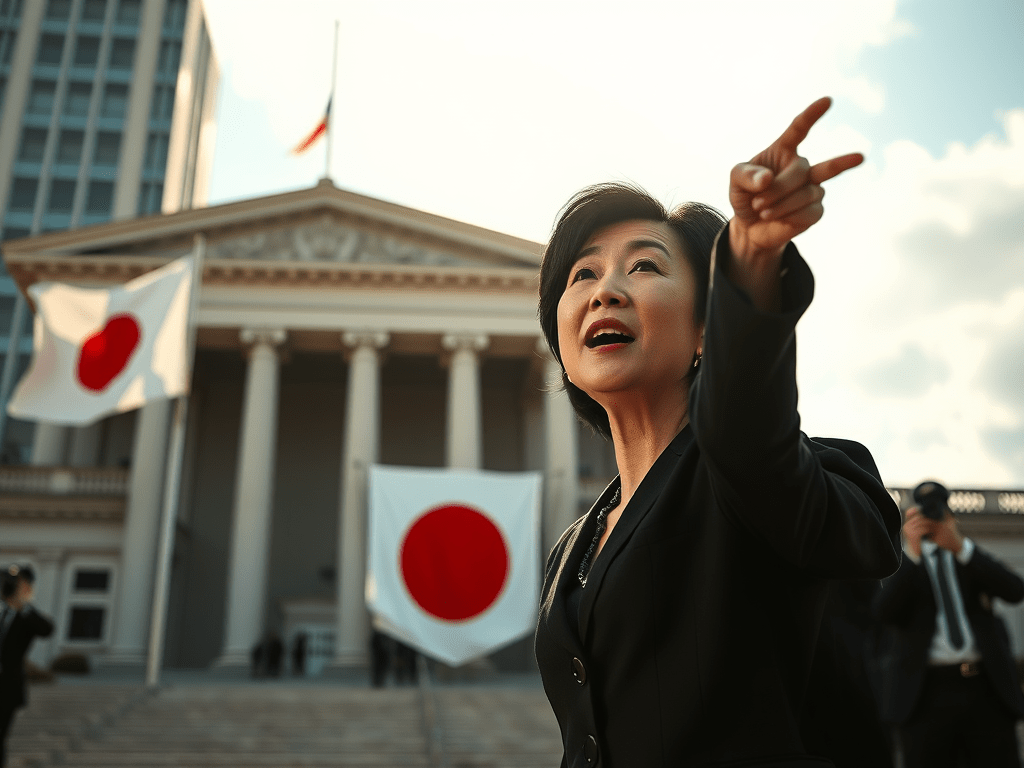
Prime Minister Sanae Takaichi faces China’s inverted reality daily. Her clear articulation that Taiwan’s security is inseparable from Japan’s — a simple geographic and strategic fact — triggers paroxysms of manufactured outrage from Beijing. Chinese state media denounce her “dangerous rhetoric” while publishing maps showing Japanese territory as Chinese and conducting military exercises explicitly simulating attacks on Japanese positions. The contradiction doesn’t matter in an inverted world, because contradiction is the point.
Understanding this inversion requires grasping the intellectual foundation upon which Beijing operates. Marxist-Leninist thought, which remains the Chinese Communist Party’s official ideology despite capitalism’s pervasive presence in China’s economy, posits that truth is not objective but instrumental: It serves the revolution, the Party, the historical dialectic.
Lenin himself wrote that “a lie told often enough becomes the truth” and that morality is “entirely subordinate to the interests of the class struggle.” This isn’t cynical hypocrisy; it’s sincere philosophical commitment to the idea that “bourgeois” concepts like objective truth or universal human rights are merely weapons wielded by class enemies.
This framework transforms international discourse from debate into weaponized narrative construction. When Beijing condemns Japan’s “militarism,” Gao and his colleagues aren’t making claims they expect to defend with evidence. They’re deploying Document 9, the CCP’s leaked 2013 internal directive that calls for resistance to “infiltration” by Western concepts like “universal values” and “civil society.” The document explicitly warns Party members against “constitutional democracy,” “historical nihilism” and “Western media concepts,” revealing a worldview where factual accuracy matters less than narrative control.
The Fukushima water release controversy of 2023 perfectly illustrated this inverted epistemology in action. Japan planned to release treated water from the Fukushima No. 1 nuclear plant after extensive purification, a process endorsed by the International Atomic Energy Agency following rigorous scientific review. Tokyo published comprehensive data, invited international verification and even offered to let Chinese experts test the water themselves.
Beijing’s response? Blanket condemnation, import bans on Japanese seafood and a propaganda campaign claiming Tokyo was “poisoning” the Pacific Ocean. When Japan invited Chinese scientists to verify the water’s safety, Beijing declined. When the IAEA confirmed the discharge met all safety standards, Chinese state media dismissed the agency as a Western tool.
The objective wasn’t truth; it was damaging Japan’s reputation, disrupting its economy and demonstrating Beijing’s capacity to mobilize public opinion against any neighbor that displeases it. The Global Times ran dozens of articles about Japan’s “environmental crime” while studiously ignoring China’s own environmental record.
This “inverted world” is operating exactly as designed. By deploying what Document 9 calls resistance to “the West’s view of media” (meaning fact-based journalism) in favor of media that serves political objectives regardless of truth.
The government of then Prime Minister Fumio Kishida responded with textbook crisis communication. They didn’t engage in tit-for-tat denunciations; they calmly presented data, welcomed international oversight and let scientific institutions speak. Within months, most nations recognized China’s campaign as disinformation. Even some Chinese citizens, accessing information through VPNs, expressed skepticism about their government’s claims.
This measured response illustrates the first prong of the strategy Japan and its partners must employ when facing China’s inverted reality: Shape international discourse through calm, fact-based explanations. Don’t match hysteria with hysteria. Don’t accept the inverted premise. Simply present reality and let the contrast speak.
But facts alone won’t penetrate China’s domestic information environment, where the Great Firewall, pervasive self-censorship and what authorities call the “Fengqiao experience” — a surveillance system that incentivizes citizens to monitor and report on each other by creating an ecosystem where truth struggles to survive.
Document 9 explicitly directs CCP members to “strengthen management of the ideological battlefield” and ensure “absolutely no opportunity or outlets for incorrect thinking or viewpoints to spread.” The document warns against “civil society,” “universal values” and even “neoliberalism,” revealing a system designed to inoculate citizens against external information.
This brings us to the second, more challenging strategy: Influencing China’s domestic environment by providing alternative models and fostering genuine people-to-people understanding.
As Yasheng Huang argues in his 2023 book “The Rise and Fall of the East,” China’s examination-driven education system has historically rewarded reproducing knowledge, not challenging it; memorizing approved answers rather than questioning assumptions. This creates citizens adept at navigating bureaucratic systems but less equipped to evaluate competing truth claims. Combined with Document 9’s explicit rejection of “historical nihilism” (meaning any historical narrative that questions CCP orthodoxy), the result is a population often insulated from alternative perspectives.
The antidote isn’t propaganda but authentic engagement. Japan must expand educational exchanges that bring Chinese students to experience actual Japanese society, not the militaristic caricature presented in China’s state media, but the pacifist democracy that’s renounced war for eight decades. These students must encounter Japan’s vibrant civil society, independent media and genuine political debate — everything Document 9 warns them against.
Equally crucial: More Japanese students and tourists must learn Mandarin, engage with China’s genuine cultural richness and understand the nation’s heterogeneity. Greater China isn’t monolithic. It includes democratic Taiwan, Cantonese-speaking Hong Kong and Guangdong, the Hakka and Hokkien communities, the Hui Muslims and Uyghur and Tibetan cultures, each with distinct identities the CCP’s narrative attempts to erase or subordinate. Understanding this plurality creates bridges to conversations that transcend Communist-approved scripts.
When Japanese visitors engage with ordinary Chinese citizens by discussing history, comparing governance models and sharing perspectives they chip away at the inverted worldview Beijing constructs. These aren’t debates won in a single conversation but seeds planted for longer-term understanding.
None of this is easy or quick. As the Sanskrit saying goes: Dhairyam sarvatra sadhanam (Patience is the means to all objectives). Confronting China’s epistemological warfare requires the long view. It demands partners committed to the same patient work of accurately presenting reality, fostering genuine exchanges and trusting that over time, facts and human connection erode even the most carefully constructed inversions.
For Takaichi, this means weathering Beijing’s diplomatic tantrums, the denunciations, the economic coercion attempts and the efforts to isolate Japan from regional partners with the steadiness that characterized Japan’s Fukushima response. It means maintaining strategic autonomy while deepening partnerships with democracies facing similar pressure. It means contributing to conditions across the Taiwan Strait that make Beijing’s coercion costly and its inversions unconvincing.
The inverted world thrives on intimidation, isolation and information control. It collapses when confronted with patient facts, genuine dialogue and the stubborn reality that truth — however unwelcome by authoritarians — eventually finds cracks in even the Great Firewall. Tokyo’s challenge is maintaining the discipline to present that truth clearly, repeatedly and without descending into the inverted epistemology it confronts.
In Priest’s novel, the city’s inhabitants eventually discover their world’s true nature, not through dramatic confrontation but through persistent observation and courageous willingness to question received wisdom. Japan’s task is similar: Help more people within China and beyond see through the inversion to the reality beneath. It’s unglamorous work requiring patience, resources and resolve. But it’s the only path through the looking glass Beijing has constructed.
This article was first published on November 26, 2025, at The Japan Times.


 nagystephen.com
Leave a comment