
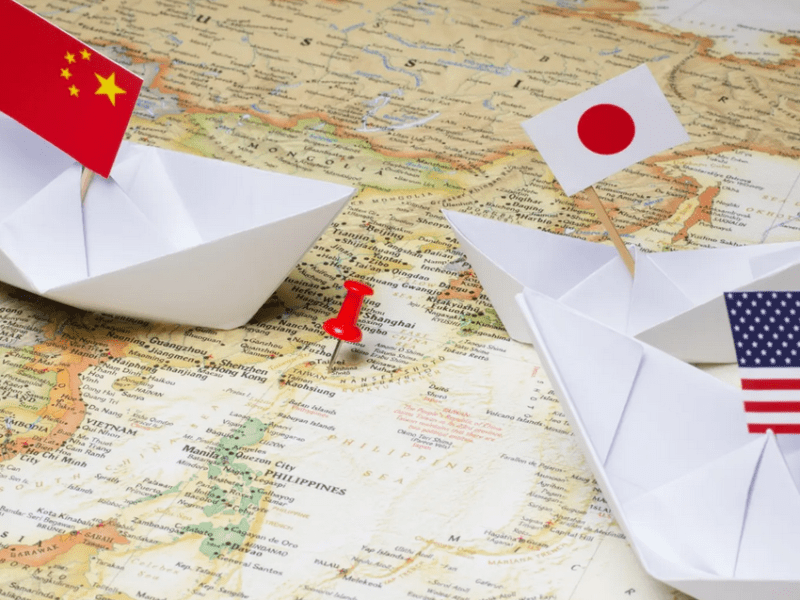
Japan’s strategic situation is stark. Its security depends on an increasingly unreliable U.S., while its prosperity depends on an increasingly assertive and revisionist China.
As Washington questions the value of alliances and Beijing demands deference from neighbors, Tokyo must confront an uncomfortable truth: The U.S.-led order that enabled Japan’s postwar success is dead and no one knows what comes next.
This isn’t another declinist prophecy about Washington’s retreat or inevitable Beijing dominance. Rather, it’s recognition that what Antonio Gramsci called an “interregnum” — that anxious period when the old order is dead or dying but the new cannot yet be born. The old rules no longer apply, but new ones haven’t emerged.
For Japan, caught between a security patron showing signs of fatigue and an economic partner seeking regional and global dominance, navigating this transition may determine whether it remains a prosperous democracy or becomes a subordinate state in a Chinese sphere of influence or worse.
Japan’s dilemma resembles the classic prisoner’s dilemma from game theory.
- If Japan strengthens ties with America just as Washington abandons its Indo-Pacific commitments, Tokyo faces isolation.
- If it accommodates Beijing while China continues coercing neighbors, Japan risks subordination.
Yet trying to maintain today’s balance — deep security ties with Washington, deep economic ties with Beijing — becomes impossible as U.S.-China strategic competition intensifies.
The unorthodoxy of the Trump 2.0 administration, including tariffs, public reprimands of state leaders in the White House and the recent red-carpet treatment for Russian President Vladimir Putin in Alaska, does not bolster credibility; it infuses deep uncertainty into the gray matter of policy makers as they face the realities of a power-makes-right Machiavellian world.
Recent events have sharpened these dilemmas. In 2023, when China banned Japanese seafood over water releases from the crippled Fukushima nuclear-power plant (a ban since lifted), economic coercion became reality. When Trump repeatedly suggests that Japan should pay more for U.S. bases or defend itself, alliance uncertainty becomes tangible. Japan can no longer assume economic rationality will restrain China or that treaty obligations will constrain America.
As Japan searches for alternatives, three models offer lessons, but none is a panacea for Tokyo’s troubled path ahead.
Southeast Asian nations practice what scholars such as Kuik Cheng-Chwee call “hedging” — maintaining security ties with the U.S. while deepening economic integration with China. Singapore hosts U.S. military facilities while being China’s largest foreign investor. Malaysia criticizes Chinese maritime claims while welcoming Belt and Road Initiative investments.
This works for smaller states that can fly below the radar. Japan cannot. Its size, capabilities and history with China ensure that every security move is scrutinized. When Japan increases defense spending or deepens “Quad” cooperation, Beijing sees containment, not hedging. States from the Association of Southeast Asian Nations can claim neutrality; Japan’s geography and disputes with China make this impossible.
Hungary pursues what is called “connectivity” — maintaining Western institutional membership while building ties with China and Russia. Hungarian Prime Minister Viktor Orban courts Chinese investment and blocks EU criticism of Beijing, yet keeps NATO membership as insurance.
Japan already practices connectivity through initiatives like the Comprehensive and Progressive Agreement for Trans-Pacific Partnership (CPTPP), which creates regional networks excluding both the U.S. and China. But Hungary’s strategy depends on EU and NATO security guarantees that Japan lacks. Geography matters too. Hungary can anger Brussels without fearing invasion; Japan antagonizing Washington while Chinese maritime power grows is a different calculation altogether, especially under a mercurial president like Trump.
Still yet another option is Switzerland’s armed neutrality. Strong self-defense with strict nonalignment may appeal to Japanese who want to avoid U.S.-China strategic competition. Japan’s pacifist Constitution already embodies neutralist impulses.
But Switzerland spent centuries building neutrality credibility and sits in Europe surrounded by democracies. Japan sits astride vital sea lanes that China increasingly controls, facing territorial disputes and North Korean missiles. Swiss neutrality works because invasion costs exceed benefits. Tokyo can’t make that calculation alone as the nation’s defense requires allied support.
Japan’s options are limited by harsh realities. Demographic decline (the population will shrink an estimated 30% by 2070) limits military capacity. Geographic vulnerability means Japan needs allies to secure sea lanes. Economic integration makes decoupling from China prohibitively expensive. Historical memories mean regional states view Japanese military growth suspiciously.
Yet Japan retains advantages often underestimated. It will remain among the top 10 largest economies for decades to come with technological capabilities China needs. Its democratic credibility attracts partners seeking alternatives to authoritarian models. Development assistance networks and cultural influence provide soft-power tools. Most importantly, Japan’s institutional expertise, from the CPTPP to infrastructure standards, allows it to shape emerging rules.
Given these realities, Japan needs a strategy that maximizes flexibility while building resilience.
Rather than choosing between Washington and Beijing, Tokyo should build a portfolio of partnerships. Deepening defense cooperation with Australia, India, Britain and France doesn’t replace the U.S. alliance but creates alternatives if American commitment falters. Economic partnerships with Southeast Asia, Europe and India reduce Chinese leverage without requiring complete decoupling.
Investing in comprehensive alignments forces unnecessary choices. Instead, build different coalitions for different challenges. Partner with democracies on technology standards, with maritime nations on freedom of navigation, with developed economies on supply-chain resilience. Work with China on climate change and regional trade where interests align.
Japan must also choose resilience over efficiency. The logic of globalization — maximizing efficiency through specialization — has become dangerous in strategic competition. The nation needs supply-chain redundancy, strategic reserves and domestic capacity in critical sectors. Yes, this raises costs. Consider it insurance against coercion.
In this crucible of instability, rather than choosing between U.S. and Chinese visions, Japan should propose alternatives. The CPTPP shows how creating high-standard trade rules attracts others. Similar initiatives on digital governance, infrastructure finance and technology standards position Japan as rule-maker, not rule-taker.
The interregnum may last decades. Premature clarity invites pressure from both sides. Like Taipei’s successful ambiguity about independence, Tokyo should maintain studied vagueness about ultimate alignments while building capabilities for multiple scenarios.
Japan is facing its most complex strategic environment since 1945, but complexity creates opportunity. The binary choice between Washington and Beijing is false and imposed by those powers for their benefit, not Japan’s. Tokyo’s interest lies in preventing either’s dominance while maintaining productive relations with both.
This isn’t neutrality or equidistance. It’s recognition that in the interregnum flexibility matters more than clarity, resilience more than efficiency and options more than obligations. Japan must prepare not for a specific future but for an uncertain one.
The post-American order hasn’t arrived and Chinese hegemony isn’t inevitable. Comprehensive tools that measure power, such as the Lowy Institute Asia Power Index, show us that. What’s certain is that the comfortable assumptions of the past 75 years no longer hold. Japan’s choice isn’t whether to accept this reality but how to shape it.
In other words, be at the table in shaping the forthcoming order, not on the menu.
Some will call this strategy hedging, others call it realism. What matters is that it preserves Japanese agency in an era when middle powers matter more than ever. As the interregnum unfolds, Japan’s success depends not on choosing the winning side but on ensuring it has choices when the new order finally emerges.
The alternative, betting everything on either U.S. reliability or Chinese benevolence isn’t a strategy; it’s gambling with Japan’s future. In the casino of great-power competition, the house always wins. Japan’s best bet is not to play by their rules but to carefully construct its own game.
The article was first published on August 28, 2025 at The Japan Times.









![[The Reality of Middle Power] US and China: “Superpowers” and “Multiple Weak Powers” on Fuji BS’ Prime NEWS](https://nagystephen.com/wp-content/uploads/2026/03/image-7.png?w=1024)
 nagystephen.com
Leave a comment