
Introduction
China’ substantial economic and military expansion since the late 20th century has generated far-reaching strategic implications that continue to reshape regional power dynamics and global governance frameworks.
Scholar Rory Medcalf of the Australian National University posits that a fundamental strategic realignment is underway, with the global center of economic and geopolitical influence progressively shifting from the Euro-Atlantic theater to the Indo-Pacific region.
The Indo-Pacific presents a fundamentally distinct strategic environment from the Euro-Atlantic region, characterized by pronounced political heterogeneity and multiple competing regional powers with divergent security interests, governance models, and territorial claims—a complexity that significantly complicates regional security architecture and multilateral cooperation frameworks.
Strategic Maritime Corridors: Securing Indo-Pacific Sea Lines of Communication as Critical Infrastructure for Economic Resilience and Regional Stability
Maritime commerce corridors constitute essential strategic infrastructure for Indo-Pacific nations, directly impacting economic security and national resilience.
As Kenneth Pyle’s analysis demonstrates, resource-constrained countries like Japan—with limited domestic production capacity relative to population requirements—face existential dependence on unimpeded access to maritime trade networks.
Japan’s national security framework necessarily prioritizes maritime access given that critical inputs for both economic functionality and societal stability—including petroleum, liquefied natural gas, rare earth minerals for semiconductor manufacturing, and substantial food imports—transit exclusively through these sea lanes.
This maritime dependence creates structural vulnerabilities that must be addressed through coordinated regional security mechanisms, particularly as traditional freedom of navigation norms faces increasing challenges from territorial disputes and strategic competition.
Nobukatsu Kanehara, one of the architects of Japan’s Free and Open Indo-Pacific vision under the second Shinzo Abe administration, also emphasizes the importance of sea lines of communications.
Japan, Kanehara argues, it is imperative that Japan as a maritime nation which boasts a claim of a more than 4 million square kilometers large exclusive economic zone in its nearby waters does not lose the initiative in the seas.
Many countries in the Indo-Pacific region share similar national interests, as they depend on predicable and stable oceans for their sustenance, both for food and commerce.
South Korea as a Key Ballast of Peace and Stability
While not geographically insular, South Korea faces comparable maritime dependencies due to its functional isolation from continental trade routes resulting from the heavily militarized DMZ along its northern border.
This geopolitical constraint effectively transforms South Korea into a maritime trade-dependent nation, with approximately 99.7% of its international trade volume transported via seaborne channels.
The strategic implications are substantial: South Korea relies on maritime corridors for 96% of its energy imports, including critical LNG shipments through the South China Sea, and for the export-oriented semiconductor and advanced manufacturing sectors that constitute 40.4% of its GDP.
Seoul’s explicitly acknowledges this vulnerability, identifying “secure and resilient maritime supply chains” as core national interests requiring both enhanced naval capabilities and multilateral cooperation frameworks. This strategic reality creates natural alignment with Japan on maritime security protocols, freedom of navigation operations, and regional maritime domain awareness initiatives, despite persistent bilateral tensions in other domains.
Key Avenues of Maritime Cooperation
(1) Maritime domain awareness (MDA)
At the heart of maritime governance lies what’s referred to as maritime domain awareness (MDA). Given the vastness and ever-changing nature of the oceans, monitoring and being able to ascertain what is going on presents a much greater challenge for states than it does on land.
MDA refers, in essence, to a clear understanding with regards to security, commerce and the environment as it pertains to the maritime domain. Like-minded countries in the region, such as Japan, South Korea or Canada ought to enhance overall awareness in the region by cooperation on join patrols and exercises, information sharing and data standardization and, to some extent, pooling of resources.
(2) Illegal, unreported and unregulated fishing (IUU)
The latter point is especially important with regards to the issue of illegal, unreported and unregulated (IUU) fishing that has shown to be a recurring problem in the Indo-Pacific. Argentina’s recent showdown with an illegal Chinese fishing fleet numbering in the hundreds put new spotlight on the phenomenon.
Japan and South Korea ought to work to combat IUU in its near region. This can be done through, in addition to the suggestions outline above on MDA, capacity building and training with key partners like the Philippines that has seen its territorial waters susceptible to shadow fleets engaging in IUU.
Canada maybe a key partner in any minilateral cooperation with its pre-existing IUU initiatives with the Philippines in providing Dark Vessel detection technology.
(3) Grey zone operations
As international tensions rise in the Indo-Pacific region, so-called grey zone operations have received much attention. Grey zone operations are essentially aggressive or coercive behavior that nevertheless fall under the threshold of war. These operations are also often associated with ambiguity, obscuring who the actor or decisionmaker behind said operation is.
Cyber-attacks, for instance, are difficult by nature to trace their origins. In the maritime domain, the use of non-military proxies such as the coast guard or fishing fleets is likewise a trend observed particularly in the East China Sea and the South China Sea as methods to avoid outright military confrontation.
In the former, while there are worries that China may in the near future attempt to undermine Japan’s Senkaku Islands incrementally through gray-zone operations, so far it has not materialized.
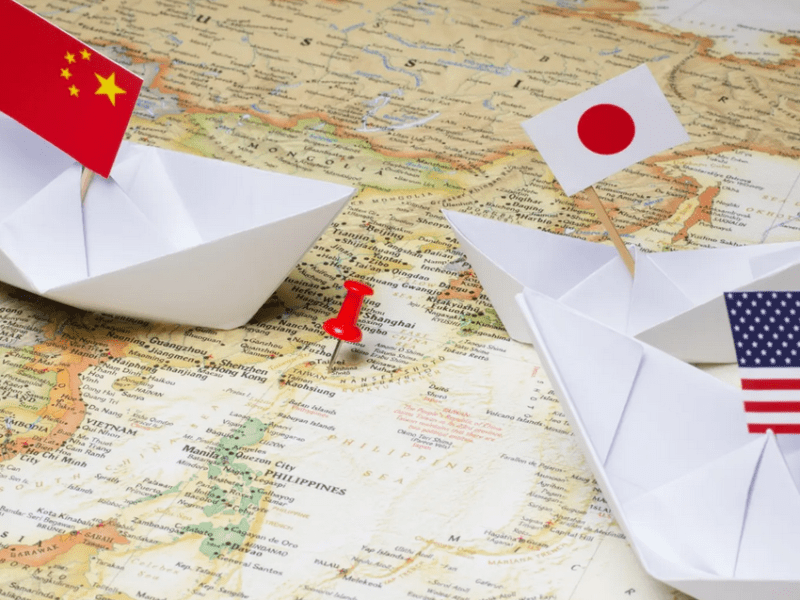
For the latter, however, China’s assertive behavior in the South China Sea is well documented. Most striking is its rapid and covert construction military facilities on several disputed islands in the region.
To prevent further exploits of strategically situated islands and maintain the political status quo, Japan ought to further expand its engagement with like-minded partners such as the Philippines, which has a vested interest in protecting its claims in the region.
Not only would further Chinese adventurism in the South China Sea potentially led to military conflict, but any successful challenge to the status quo may also embolden it to do the same in the East China Sea or, potentially, in the Taiwan Strait.
Any large-scale conflict breaking out in the region would have devastating effects on the world economy, not only considering the volume of trade passing through the many geographic chokepoints in the region but also the overall strategic shift it would spell for the region.
Indo-Pacific South Korea
The feasibility of South Korea’s Indo-Pacific vision has been called into question given the domestic political situation. The challenges are set to continue as the country just began its new government.
Whichever the outcome, it is clear that South Korea’s interests overlap substantially with that of Japan when it comes to maritime cooperation.
Any doubts should consider what escalating tensions would mean for the country, especially when considering reports of China eyeing unilateral action towards Taiwan.
Author BIO
William Winberg is PhD Candidate at the International Christian University and intern for the Yokosuka Council of Asia-Pacific Studies (YCAPS)
Stephen Nagy is a Professor at the Department of Politics and International Studies at the International Christian University. Concurrently, he is a senior fellow at the MacDonald Laurier Institute (MLI), a fellow the Canadian Global Affairs Institute (CGAI); a senior fellow with the East Asia Security Centre (EASC); & a visiting fellow with the Japan Institute for International Affairs (JIIA).









 nagystephen.com
Leave a comment