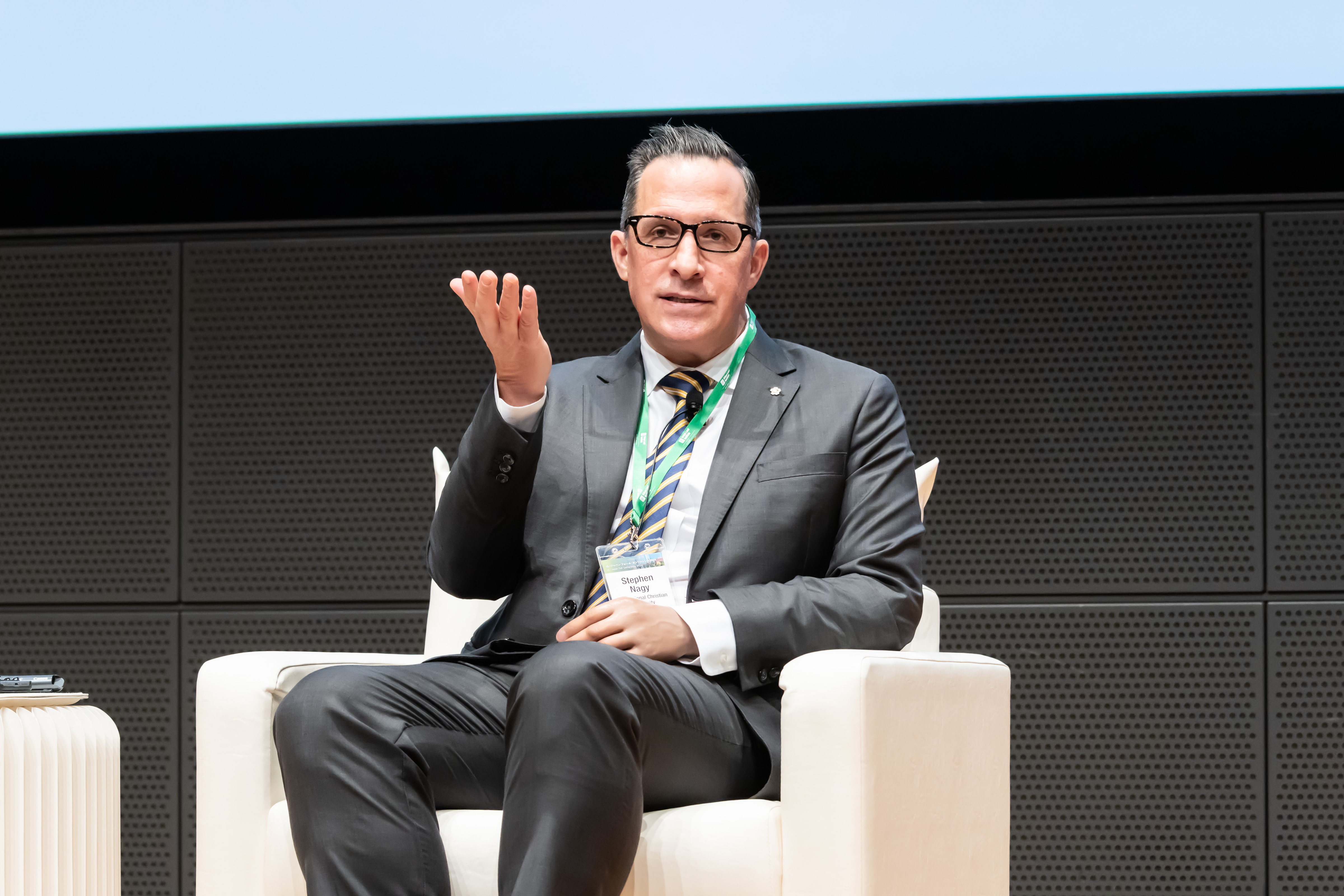
Q: How would you summarise the relationship between South Korea and Japan during Yoon’s presidency?
Stephen Nagy: I would summarise it as a relationship that evolved in quite a positive direction. When Yoon came into power, there was great hesitancy in Tokyo in terms of accepting his reach-out because, frankly, from the Japanese point of view, the previous administration was quite antagonistic towards the Japanese. And it was a fundamental negative shift in bilateral relations. Yoon worked hard to build that trust. And with time, the Kishida administration saw it as a positive and welcomed President Yoon to the G7 summit to observe the Quad summit meetings, and eventually agreed to the trilateral Camp David meetings with President Biden. So it moved again. It evolved from a period of mistrust to one that was seen as a partnership that could move forward. And today, I think there’s probably great disappointment in Tokyo with the impeachment of President Yoon, and the possibility of relationships moving back to a more antagonistic position, as they were in the previous administration in South Korea.
Q: Right. So you said there’s perhaps disappointment in Tokyo over the impeachment. Can you expand a bit more on that for us? How has Japan viewed the ouster of Yoon and the snap presidential election that’s coming up on June 3rd? Has Japanese Prime Minister Shigeru Shiba made any sort of remarks on the current political situation here?
Stephen Nagy: Well, it’s Northeast Asia. They generally say the same thing — they want stable and constructive relations. But behind closed doors, I think that there’s great concern that a potential progressive administration will be elected in South Korea. It will return to focusing on very public disputes over the labor issues and the comfort women issue, and that positions, for example, on Taiwan or on China or on the broader Indo-Pacific, will be peeled back. And from Tokyo’s perspective, this is fundamentally not in its interests. Tokyo — and I would argue South Korea — live in a tough neighborhood. North Korea’s nobody’s friend. Increasingly, we see coordination between Russia and China and some of their activities to destabilize the region. And China continues to expand its grey zone operations in the East China Sea, across the Taiwan Strait, and in the South China Sea, which are hugely destabilizing. And just to put it into context, about 5.5 trillion U.S. dollars of trade goes through the South China Sea. About 2.3 trillion U.S. dollars in and around Taiwan. And these feed the economies of Japan, South Korea, and frankly, China. A disruption here, or a decrease in cooperation between South Korea and Japan, has the potential to fundamentally destabilize the region’s economy.
Q: Where do you think Trump stands on the trilateral cooperation?
And do you think the outcome of South Korea’s presidential election will have any effect on Trump’s thinking and the trilateral cooperation?
Stephen Nagy: Well, I think President Trump in his first term, and in his career, and so far in his second term, has demonstrated that he is, first and foremost, a “Make Trump Great Again” kind of approach to every single policy. So I think the position he’ll take will really be dependent on what kinds of domestic pressures he’s facing. So if he feels it’s in his interest to foster trilateral cooperation, then I think he’ll do it. If he feels that it’s not in his interest — it’s in his interest to escalate tensions towards South Korea, try to renegotiate KORUS, or push the Japanese on trade — he’ll do it. I think, again, primarily he doesn’t have an understanding of the trilateral issues.
It’s more about what his position is and how he can best leverage this for, again, making Trump great again. I don’t mean to be political about this. I just think that’s his pattern of behavior, and we’re going to see this move forward already. He couldn’t solve the Ukraine-Russian war in one day, and he’s pivoted to tariffs because tariffs is the next game in town — and tariffs haven’t been particularly good for the global economy or the U.S. economy.
And he’s already pivoting to the next issue: Iran. So I think this is the pattern of behavior that we should be watching — and looking at how he sees this as a political advantage for his domestic politics, rather than actually bringing stability to this region and to these critical partners to the United States.



![[The Reality of Middle Power] US and China: “Superpowers” and “Multiple Weak Powers” on Fuji BS’ Prime NEWS](https://nagystephen.com/wp-content/uploads/2026/03/image-7.png?w=1024)
 nagystephen.com
Leave a comment