Question: Now, with the shadow of uncertainty in the White House, it is not just in the U.S., is it? This is perhaps one of the first summits in a while where we’re seeing leaders gathered at the table. Whatever they agree on, if they agree on anything, they might not be there in a few months to make sure these deals are pushed through.
Stephen Nagy: That’s right. There’s a lot of uncertainty among the G20 leaders. The reality is this is not the election year of incumbents. We’ve seen this with Mr. Trump’s election, but other governments as well have seen incumbent leaders leave. So really, what’s decided at the G20 will be somewhat tentative. Everybody’s waiting for the changes in the White House in January and what the Trump 2.0 Administration will bring. No one really knows, but what we do know is that Mr. Trump will come in with a new agenda—an agenda that focuses on peace through strength, tariffs, and moving away from the Biden administration’s systemic, sequential, and allies-first approach to foreign policy in East Asia.
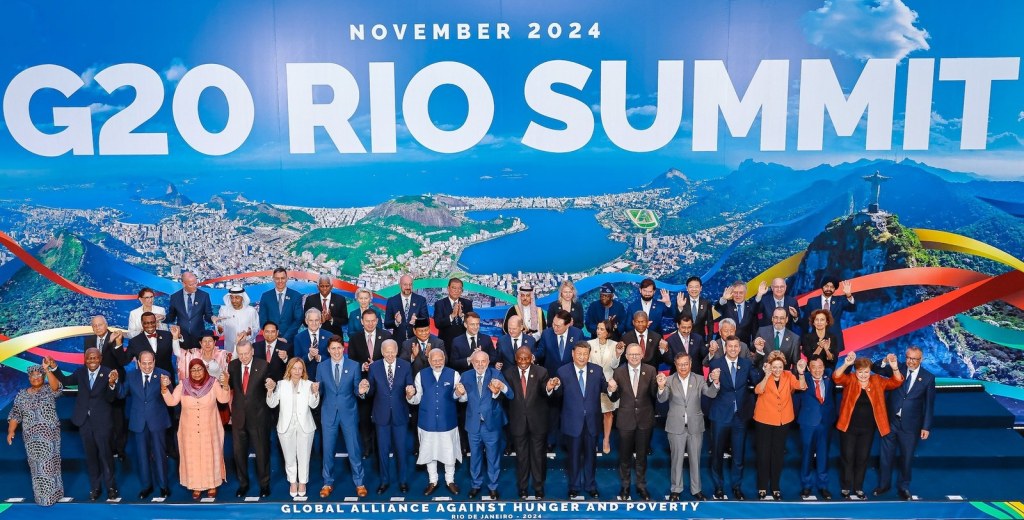
Decisions made at the G20 will likely be tentative, with many awaiting the Trump 2.0 Administration’s direction in January.
Question: So, looking at campaign slogans like “securing peace through strength,” what promises were made in the campaign? What has been said by key figures around Mr. Trump, and who he has appointed to key positions in both domestic and foreign policy?
Stephen Nagy: We’ve seen the nomination of Mark Rio, a China hawk who is banned from visiting China and has advocated for strong positions on Taiwan that go against the one-China policy. This is going to be a game-changer for U.S.-China relations. Bob Lighthizer, former U.S. Trade Representative, has advocated for 60% tariffs on products made in China. This will fundamentally put more downward pressure on the Chinese economy and also put pressure all the economies that depend on China within Asia—whether it’s Japan, South Korea, or Southeast Asian countries. They have a complex and generally positive economic relationship with China, but there are challenges in those bilateral relations.
In terms of security and defense, diplomacy, and trade, the leaders in East Asia are looking for how they can build bridges while preventing challenges that may emerge from a tougher, leaner, and meaner Trump Administration.
In response to a potentially tougher Trump Administration, East Asian leaders are seeking ways to build bridges while addressing emerging challenges in security, defense, diplomacy, and trade.
Question: We’ve seen a resumption of trade deals and the restarting of free trade talks between China, South Korea, and Japan after they had stalled for years. So, despite these security challenges, they are finding their ways around on trade.
Stephen Nagy: It’s true. We should be clear that the region is very heterogeneous with lots of different relationships with Washington. I do think Tokyo will probably do much better with the Trump Administration in terms of deepening alliances and strengthening positions in the South China Sea and the Sea of Japan. South Korea may have a more difficult time as it deals with the Trump Administration, which often demands that South Korea put more on the table in terms of self-defense. In Southeast Asia, these countries don’t want to choose between the United States and China. Their leaders consistently say they want strong partnerships with both China and the US. With that, they’re going to start building bridges and invest in the Regional Comprehensive Economic Partnership. Likely, they will expand the Comprehensive Progressive Trans-Pacific Partnership. I think they’re going to find ways to cooperate on issues like the environment, piracy, and illegal, unregulated and undocumented (IUU) fishing. At the same time, they’ll invest in minilateral relationships, such as the South Korea-Japan-U.S. relationship, to demonstrate that they’re increasing the burden-sharing that the U.S. is demanding. It’s a mixed bag of working with the U.S., working with partners in East Asia, and investing in deterrence and resilience in their own economies.
Overall, countries are balancing collaboration with the U.S. and regional partners while investing in their own economic resilience and deterrence.
Question: This notion of sharing the burden was a repeating call during Mr. Trump’s first time in office. Key voices around him have stressed they are not against alliances but want reciprocity. We’ve seen that between 2017 and now. Japan has increased its defense spending, enhanced its defense cooperation with the U.S. and Australia, and lifted the limit on weapons exports. Is the U.S., particularly regarding Japan, convinced that Japan is doing its part to share the security burden?
Stephen Nagy: My sense is yes. We’ve seen the Japanese, through their diplomatic outreach, really invest in the U.S. and the think tanks and political communities that will provide ideas to the Trump Administration. They’ve funded what we call Japan chairs at the Hudson Institute, Heritage Institute, and other conservative think tanks to promote Japan’s interests and align them with making America great again. This has been a strategy used by the Abe Administration, and I think this will be the game plan for Japan moving forward.
Other partners in the region, whether it’s Australia, South Korea, or even Singapore, will look to this playbook to help make America great again by contributing to U.S. interests while not alienating their key trading partner, China. You can’t divorce from China; there’s no decoupling from China. They have to work with China.
You can’t divorce from China; there’s no decoupling from China. They have to work with China.
Question: Has South Korea been able to do that? Does it have the leverage to do so?
Stephen Nagy: The current U.S. Administration is not in a popular state right now. On my recent visit, most supporters of the administration, as well as progressives, don’t see his policies surviving beyond his administration, which ends in about two years. This will be a challenge. How can he institutionalize some of the changes he’s implemented, whether that’s the trilateral relationship between the U.S., Japan, and South Korea, or relocating some semiconductor manufacturing capabilities away from Taiwan or having an Indo-Pacific strategy that mentions Taiwan. The survival of these initiatives will depend on who comes into power and whether the U.S. Administration can effectively work with South Korea in the last two years to institutionalize these gains, demonstrating South Korea’s commitment to the U.S.-ROK alliance and increasing its burden-sharing.
Question: One criticism of the Biden Administration is that while it promised to work with allies and partners—something they’ve done—there’s an accusation that they have failed to be equally strong on economic policy, especially in Asia, where trade is strategic under Mr. Trump. Do you see these relations becoming less securitized and moving more towards building on trade under Mr. Trump? Is there any likelihood of that?
Stephen Nagy: Unfortunately, I see the Trump Administration really investing in strengthening the industrial base in North America and focusing on the U.S. This means renegotiating the NAFTA 2.0 agreement and extracting more trade agreements between Japan and other states at the bilateral level. This will be a challenge for the region. The region’s neighbors to China believe there’s no future economic prosperity without a Chinese economy. They will continue to engage with both China and the U.S. while building resilience in their economies through diversification and also investing in deterrence in response to the complicated security challenges facing the region. They will continue to engage because that is really the only game in town for countries in the region.
Countries in the region will continue to engage with both China and the U.S. while enhancing their economic resilience through diversification and investing in deterrence to address the complex security challenges they face.



![[The Reality of Middle Power] US and China: “Superpowers” and “Multiple Weak Powers” on Fuji BS’ Prime NEWS](https://nagystephen.com/wp-content/uploads/2026/03/image-7.png?w=1024)
 nagystephen.com
Leave a comment