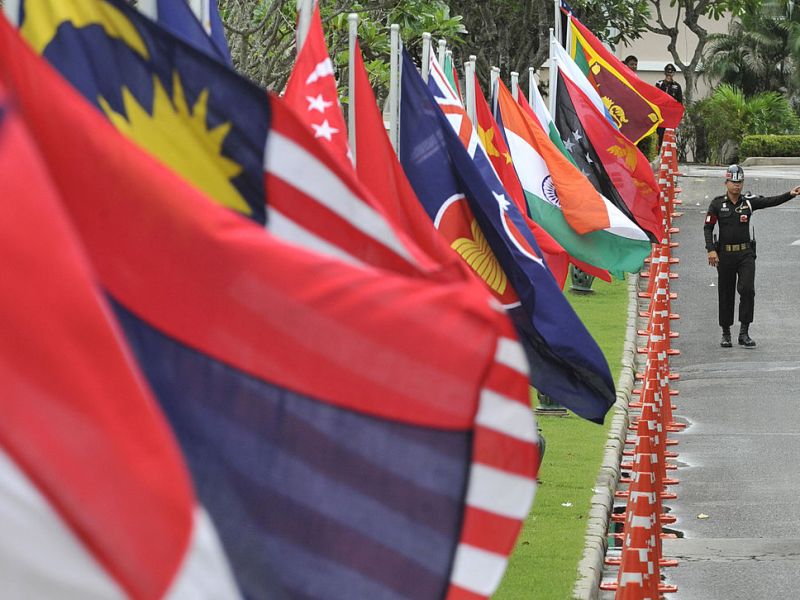
In my co-edited book with my colleague Dr. Indu Saxena, we chose Southeast Asia as opposed to ASEAN because we believe the heterogeneity of Southeast Asia makes ASEAN less cohesive. Consequently, we had to examine each state individually to understand how they view the region and how they navigate the challenges posed by the U.S.-China strategic rivalry. Our goal was to gain a better understanding of how this region can cohesively bring together its diverse parts.
An important question we explored was the findings of our research. We discovered that the region’s heterogeneity leads to varying approaches to the Indo-Pacific. For instance, Vietnam, with its “four no’s” policy, looks at the region differently. It seeks to balance its relationship with China due to historical and political factors, while also addressing significant security challenges. Vietnam uses the Indo-Pacific framework to engage extra-regional partners like Japan and India.
Singapore as a small country must balance its interests within the region. Malaysia, Indonesia, and the Philippines also face serious challenges in the South China Sea, complicating their ability to balance interests with China and their long-term relationships with the United States. My co-author and I aimed to highlight these nuances by collaborating with Southeast Asian scholars from Indonesia, the Philippines, Singapore, and Vietnam.
Three key lessons for Canada
First, it’s crucial to recognize the region’s heterogeneity, which complicates partnership dynamics. Canada should carefully choose its partners, focusing on stronger and more stable countries like Singapore, Vietnam, and potentially Indonesia and the Philippines, as they are key players in the region.
Second, understanding the security dynamics with major powers like the U.S. and China is essential. While these countries often claim neutrality, their policies reveal a tilt towards the United States, which they perceive as a stable power that adds value to the region.
Third, the region looks to extra-regional partners to balance their relationship with China. This presents an opportunity for Canada to invest smartly and strategically in the region. Canada should concentrate on specific countries where it can build alignment and synergies, leveraging these for broader cooperation and engagement.
Order our book at: https://novapublishers.com/shop/southeast-asia-and-the-indo-pacific-construct/
Related Posts


![[The Reality of Middle Power] US and China: “Superpowers” and “Multiple Weak Powers” on Fuji BS’ Prime NEWS](https://nagystephen.com/wp-content/uploads/2026/03/image-7.png?w=1024)
 nagystephen.com
Leave a comment