
Excerpt from my article “Middle Power alignment in the Indo-Pacific: Securing agency through Neo-middle Power Diplomacy”
The distinction between great powers, middle powers and small powers has become more pronounced. During the Cold-War, the US and Soviet Union were understood as superpowers competing for global dominance. Their comprehensive power as economic, ideological and military strength far surpassed all other states accounting for their central roles in the organization of the international system at the time.
During this period, traditional middle powers such as Australia, Canada and other European states pursued normative-based policies focusing on human rights, human security, the advocacy of disarmament, and the banning of landmines (Behringer, 2005).
As middle powers, their limited capacities required them to focus on issues that were tolerated by the superpowers. Importantly, their relationship with the globally engaged US allowed middle powers to carve out a role on “soft” issues, a relationship that is being challenged (Paltiel, 2019).
The diplomacy engaged in by middle powers during the Cold War is not explained by scholars that stress power, hierarchy, and order in their analysis of the international system. Most scholars focus on great powers and other states as sub-structural units (Waltz, 2010). This view reflects traditional views of international relations with survival, self-help and a view of international affairs being the core logic behind the behavior of states.
Important as they are to understanding the logic behind state behavior, this line of thinking does not give us insight into what the role of states that find themselves in the middle of the power continuum between great/superpowers such as the US and China, and small powers such as Nepal, Greece or Cambodia.
The diversity of middle-power definitions and their use to describe all manner of states leads to substantial confusion. Hence defining a middle power is a challenge to students, scholars and practitioners.
Robertson, 2017
Others view middle powers through the lens of functional capabilities, that is states that participate in multilateral and peacekeeping affairs; and states with moderate international influence are referred as ‘middle power’ states (Chapnick 1999: 74).
Chapnick also conceptualizes middle powers in terms of function, behavior and hierarchy (Chapnick 1999: 73-82).
- At the functional level: a state that can influence areas and functions in international relations is considered a middle power.
- At the behavior level: If a country plays a role thought to be of a middle power or if it identifies itself as such.
- At the hierarchical level: a state can be determined a middle power if we rank and categorizes states related to their capabilities.
Based on Chapnick’s model, states such as Australia, Canada, Japan, India and South Korea are middle powers as their behavior reflect “the tendency to pursue multilateral solutions to international problems, the tendency to embrace compromise positions in international disputes, the tendency to embrace notions of ‘good international citizenship’ to guide…diplomacy.”
Neack 2000; Cooper 1993
The functional approach that Chapnick argues contrast with scholars such as Ping who argues that power is provided by strategic territory, military and economic resources, ideology and level of economic development (Ping, 2017).
Ping puts forward the idea that there is no designed formula or model to identify middle power and identification rather rests on the ability of the definer. Therefore, the source of power and identification of the middle position is significant (Ping 2017:12).
Neack asserts that middle powers help to maintain international order through coalition building, serving as mediators and “go-betweens” as well as through international conflict management and conflict resolution activities such as United Nations peacekeeping (Neack, 2000).
There is an imperative that middle powers have “a moral responsibility and collective ability to protect the international order” from those who would threaten it; and this is the rationale behind middle powers performing these internationalist activities.
Neack, 2000
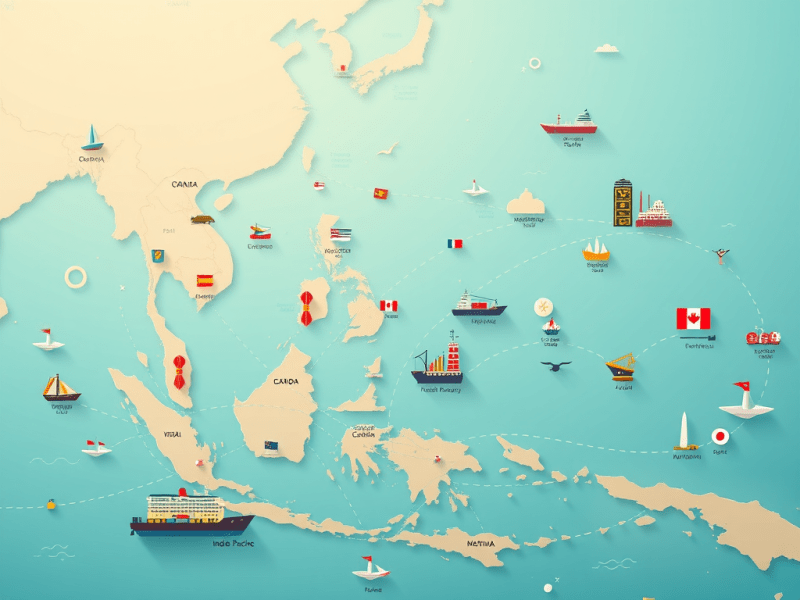
States such as India, Japan and Australia, based on the rank of their capabilities within the Indo-Pacific region are generally identified as either major powers in the case of India and Japan or a middle power as in the case of Australia.
Interestingly, according to the Lowy Institute’s 2018 Power Index, these states are closer in relative power to each other compared with the difference between China and US, the identified great powers.
Thus, for this paper Australia, Japan and India that will be considered collectively as middle powers of the Indo-Pacific. Borrowing from my paper on middle power cooperation in the maritime domain of the Indo-Pacific:
Neo-middle power diplomacy is understood as proactive foreign policy by middle powers that actively aims to shape regional order through aligning collective capabilities and capacities.
Nagy, 2020
What distinguishes neo-middle power diplomacy from so-called traditional middle power diplomacy is that neo-middle power diplomacy moves beyond the focus of buttressing existing international institutions and focusing on normative or issue-based advocacy such as human security, human rights or the abolition of land mines, to contributing to regional/global public goods through cooperation, and at times in opposition to, the middle powers’ traditional partner, the US.
Areas of cooperation [may include] … maritime security, surveillance, HADR, joint transits, amongst others.
Summary
| Author (Year) | Middle Power |
|---|---|
| Behringer (2005) | During the Cold War, traditional middle powers such as Australia, Canada and other European states pursued normative-based policies focusing on human rights, human security, the advocacy of disarmament, and the banning of landmines |
| Paltiel (2019) | As middle powers, their limited capacities required them to focus on issues that were tolerated by the superpowers. Importantly, their relationship with the globally engaged US allowed middle powers to carve out a role on “soft” issues, a relationship that is being challenged. |
| Waltz (2010) | sub-structural units survival, self-help -> core logic behind the state behavior |
| Robertson (2017) | The diversity of middle-power definitions and their use to describe all manner of states leads to substantial confusion -> Defining a middle power is a challenge to students, scholars and practitioners. |
| Chapnick (1999) | States that participate in multilateral and peacekeeping affairs; and states with moderate international influence |
| Chapnick (1999) | At the functional level: a state that can influence areas and functions in international relations is considered a middle power. |
| Chapnick (1999) | At the behavior level: If a country plays a role thought to be of a middle power or if it identifies itself as such. |
| Chapnick (1999) | At the hierarchical level: a state can be determined a middle power if we rank and categorizes states related to their capabilities. |
| Neack (2000); Cooper (1993) | Based on Chapnick’s model, states such as Australia, Canada, Japan, India and South Korea are middle powers as their behavior reflect “the tendency to pursue multilateral solutions to international problems, the tendency to embrace compromise positions in international disputes, the tendency to embrace notions of ‘good international citizenship’ to guide…diplomacy.” |
| Ping (2017) | Power is provided by strategic territory, military and economic resources, ideology and level of economic development. |
| Ping (2017) | There is no designed formula or model to identify middle power and identification rather rests on the ability of the definer. Therefore, the source of power and identification of the middle position is significant |
| Neack (2000) | Middle powers help to maintain international order through coalition building, serving as mediators and “go-betweens” as well as through international conflict management and conflict resolution activities such as United Nations peacekeeping. |
| Neack (2000) | There is an imperative that middle powers have “a moral responsibility and collective ability to protect the international order” from those who would threaten it; and this is the rationale behind middle powers performing these internationalist activities. |
| Nagy (2020) | Neo-middle power diplomacy is understood as proactive foreign policy by middle powers that actively aims to shape regional order through aligning collective capabilities and capacities. |
| Nagy (2020) | What distinguishes neo-middle power diplomacy from so-called traditional middle power diplomacy is that neo-middle power diplomacy moves beyond the focus of buttressing existing international institutions and focusing on normative or issue-based advocacy such as human security, human rights or the abolition of land mines, to contributing to regional/global public goods through cooperation, and at times in opposition to, the middle powers’ traditional partner, the US. |
| Nagy (2020) | Areas of cooperation [may include] … maritime security, surveillance, HADR, joint transits, amongst others. |
My YouTube Playlist on Middle Power and the Indo-Pacific
Latest Posts
![[The Reality of Middle Power] US and China: “Superpowers” and “Multiple Weak Powers” on Fuji BS’ Prime NEWS](https://nagystephen.com/wp-content/uploads/2026/03/image-7.png?w=800&h=600&crop=1)

Something went wrong. Please refresh the page and/or try again.
![[The Reality of Middle Power] US and China: “Superpowers” and “Multiple Weak Powers” on Fuji BS’ Prime NEWS](https://nagystephen.com/wp-content/uploads/2026/03/image-7.png?w=1024)
 nagystephen.com
Leave a comment