
Excerpt from my Chapter “The IPEF: Japan’s Economic Realism and Approach to Indo-Pacific Engagement, Resilience, and Rule-Setting”
Japan’s interests in the IPEF can be traced back to its long-standing commitments to free trade and open markets. Since it became a major trading nation in the late 1800s, with limited natural resources, Japan has relied heavily on international trade to fuel its economic growth. This reliance has necessitated a rules-based order and access to resources and consumer markets.
With the US stepping away from the TPP in January 2017, Japan and other TPP partners were left standing at the trade altar. Even though the possibility was unlikely, many had hoped that the US would return to the TPP. In an exclusive interview with CNBC and Broadcast Satellite Japan, former Prime Minister Shinzo Abe said, “Since the US understands the importance of having free and fair trade rules, it is our wish, by all means our strong wish is that the US will return to TPP.”
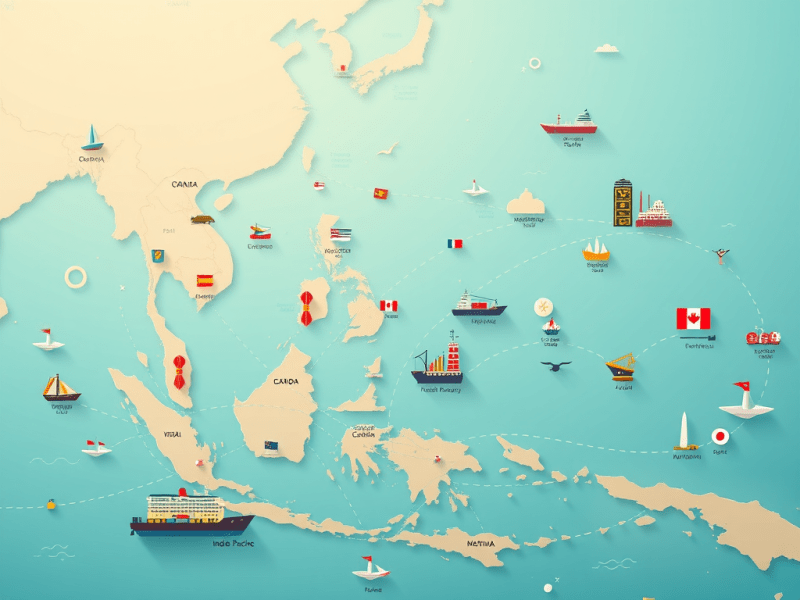
The Biden administration, understanding that advocating for joining the CPTPP was a non-starter for the US due to domestic political divisions, launched the IPEF in May 2022 with 14 diverse partner countries representing 40 per cent of global Gross Domestic Product (GDP) and 28 per cent of global goods and services.

Despite not discussing market access, the IPEF offers numerous advantages to its members that distinguish it from traditional trade agreements. These include the ability for IPEF participants to choose from a range of initiatives falling under the IPEF umbrella, as well as its focus on trade, supply chains, the clean economy, and a fair economy.
The emphasis on these areas aims to promote sustainable economic growth and development for all participating countries. The à la carte approach to the IPEF membership ensures that states with different politico-economic systems and at different levels of development can join the Framework without being compelled to adopt all parts of the initiative. This feature contributes to the IPEF’s inclusivity.
The four pillars of the IPEF are core foundations for stable and rules-based growth in the region that will translate into a clean, green, resilient, technological, and fair economy.
The Trade Pillar stresses “trade and technology policies that advance a broad set of objectives and that fuel economic activities and generate investments; promote resilient, sustainable, and inclusive economic growth and development; and benefit workers, consumers, indigenous peoples, local communities, women, and micro-, small-, and medium-sized enterprises (MSMEs).” The Pillar links the growing theme of economic security to technology and development to resilience. In the former, Tokyo sees its economic security related to being at the forefront of technological development and also in setting of rules for inculcating these technologies into the Indo-Pacific’s economic growth. In the latter, the Pillar links development to building resilience into economies reducing their vulnerabilities to economic destabilisation from financial crises, natural disasters, supply chain breakdowns, or economic coercion by other states.
The Supply Chains Pillar aims to “ensure secure and resilient supply chains and to minimise disruptions and vulnerabilities, which may require evolving our public institutions and improving coordination with the private sector. Recognising the different economic characteristics and capacity constraints of Members, we seek to coordinate crisis response measures and to expand cooperation to better prepare for, and mitigate the effects of, disruptions to better ensure business continuity and improve logistics and connectivity, particularly in critical sectors.”
The realisation of acute vulnerabilities of an overconcentration of supply chains in one country is related to economically coercive behaviour, conflict, and erratic policy choices in China over the COVID-19 pandemic. With regard to economic coercion, Japan, South Korea, Australia, Canada, Taiwan and other states have experienced coercion by China, and see selective diversification of supply chains as being essential for building resilience into their economies.
Conflict – current and possible in the case of Taiwan – also weighs heavily in the minds of Japan and other IPEF members. The downstream effects of Russia’s invasion of Ukraine on food security and energy security have amplified concerns about global supply chains with Prime Minister Kishida Fumio stressing “today’s Ukraine could be tomorrow’s East Asia”, an indirectly labelled concern about China’s assertive behaviour and militarisation in the region as threats towards Taiwan. The supply chains disruptions experienced after the COVID-19 pandemic and those associated with China’s Dynamic Zero COVID-19 policies have also led to the realisation that politically-based policy choices within China can destabilise supply chains prompting the IPEF members to diversify, build resilience and de-risk from volatile policy environments.
The Clean Economy Pillar aims to promote “clean energy transitions, scaling and reducing the cost of innovative technologies, and advancing low greenhouse gas emissions in priority sectors. Specifically, the proposal seeks to create a framework through which IPEF partners can identify new opportunities and advance existing efforts in shared areas of interest to promote the resiliency, innovation, sustainability, and security of a clean economy and to support ongoing collaboration among IPEF Partners and stakeholders.” The Pillar recognises that sustainable and environmentally friendly growth is a prerequisite for developed and developing nations with many of the latter (for example, the Pacific Island countries) facing existential climate change challenges.
Lastly, the Fair Economy Pillar recognises that “fairness, inclusiveness, transparency, the rule of law, and accountability are essential to improving the investment climate, ensuring shared prosperity, and promoting labo[u]r rights based on the ILO Declaration on Fundamental Principles and Rights at Work, which the Partners have adopted.” Overlapping with the labour components of the CPTPP, the Pillar aims to create a level playing field for the IPEF members, for ensuring economies compete on mutual understanding of labour rights and the necessity to invest in greener and labour-friendly economic practices.
Read my full chapter:
Find more chapters:
![[The Reality of Middle Power] US and China: “Superpowers” and “Multiple Weak Powers” on Fuji BS’ Prime NEWS](https://nagystephen.com/wp-content/uploads/2026/03/image-7.png?w=800&h=600&crop=1)


![[The Reality of Middle Power] US and China: “Superpowers” and “Multiple Weak Powers” on Fuji BS’ Prime NEWS](https://nagystephen.com/wp-content/uploads/2026/03/image-7.png?w=1024)
 nagystephen.com
Leave a comment